Mostrando postagens com marcador Olerícolas. Mostrar todas as postagens

domingo, 22 de julho de 2018

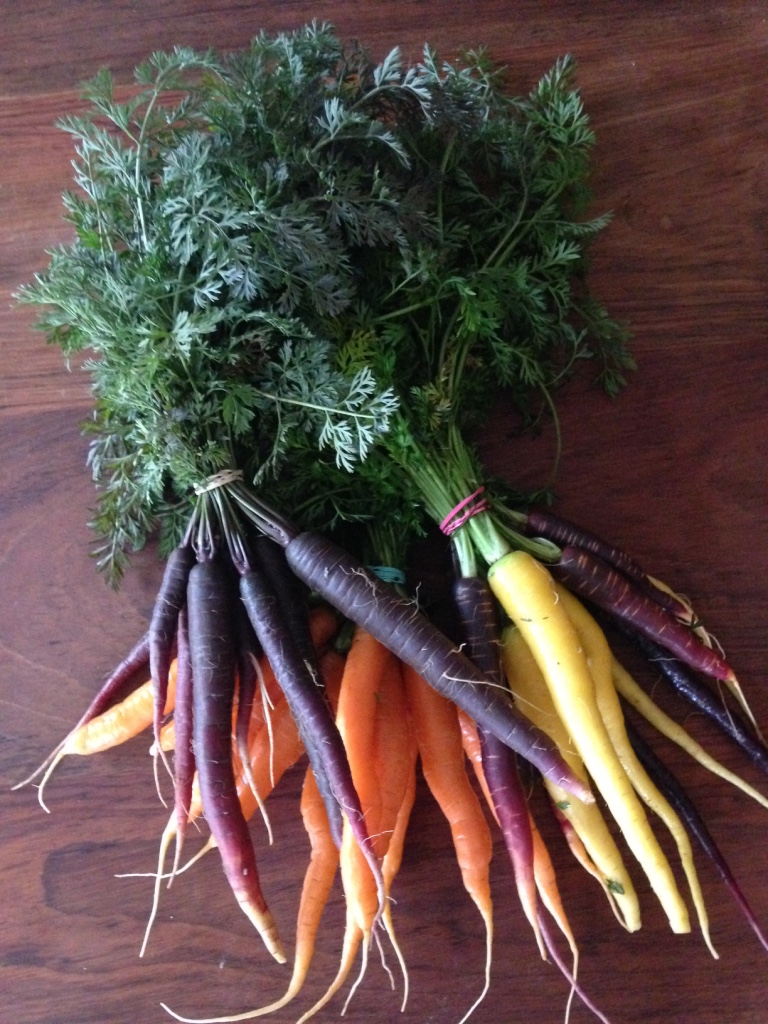
Carrot top pesto through the looking glass

Link:
https://botanistinthekitchen.blog/2017/09/23/carrot-top-pesto-through-the-looking-glass/
Posted on September 23, 2017 by Jeanne L. D. Osnas 

Isomers are molecules that have the same chemical constituents in different physical arrangements. Some terpenoid isomers have very different aromas and are important food seasonings. A batch of carrot top pesto led to an exploration of intriguing terpenoid isomers in the mint, carrot, and lemon families.
“Oh, c’mon. Try it,” my husband admonished me with a smile. “If anyone would be excited about doing something with them, I should think it would be you.”

The “them” in question were carrot tops, the prolific pile of lacy greens still attached to the carrots we bought at the farmer’s market. I have known for years that carrot tops are edible and have occasionally investigated recipes for them, but that was the extent of my efforts to turn them into food. My excuse is that I harbored niggling doubts that carrot tops would taste good. Edible does not, after all, imply delicious. My husband had thrown down the gauntlet, though, by challenging my integrity as a vegetable enthusiast. I took a long look at the beautiful foliage on the counter.

“Fine,” I responded, sounding, I am sure, resigned. “I’ll make a pesto with them.”

Carrot tops, it turns out, make a superb pesto. I have the passion of a convert about it, and not just because my carrot tops will forevermore meet a fate suitable to their bountiful vitality. The pesto I made combined botanical ingredients from two plant families whose flavors highlight the fascinating chemistry of structural and stereo isomers.

sábado, 8 de abril de 2017

Fruits and vegetables' latest superpower? Lowering blood pressure

Dietary potassium linked with lower blood pressure

Date: April 5, 2017

Source: University of Southern California - Health Sciences

Summary:
A new study links increased dietary potassium with lower blood pressure.
Fresh fruits and vegetables.
Credit: © Serghei Velusceac / Fotolia

Eating potassium-rich foods like sweet potatoes, avocados, spinach, beans, bananas -- and even coffee -- could be key to lowering blood pressure, according to Alicia McDonough, PhD, professor of cell and neurobiology at the Keck School of Medicine of the University of Southern California (USC).

"Decreasing sodium intake is a well-established way to lower blood pressure," McDonough says, "but evidence suggests that increasing dietary potassium may have an equally important effect on hypertension."

Hypertension is a global health issue that affects more than one billion people worldwide. The World Health Organization estimates that hypertension is responsible for at least 51 percent of deaths due to stroke and 45 percent of deaths due to heart disease.

McDonough explored the link between blood pressure and dietary sodium, potassium and the sodium-potassium ratio in a review article published in the April 2017 issue of the American Journal of Physiology -- Endocrinology and Metabolism. The review looked at population, interventional and molecular mechanism studies that investigated the effects of dietary sodium and potassium on hypertension.

McDonough's review found several population studies demonstrating that higher dietary potassium (estimated from urinary excretion or dietary recall) was associated with lower blood pressure, regardless of sodium intake. Interventional studies with potassium supplementation also suggested that potassium provides a direct benefit.

McDonough reviewed recent studies in rodent models, from her own lab and others, to illustrate the mechanisms for potassium benefit. These studies indicated that the body does a balancing act that uses sodium to maintain close control of potassium levels in the blood, which is critical to normal heart, nerve and muscle function.

"When dietary potassium is high, kidneys excrete more salt and water, which increases potassium excretion," McDonough says. "Eating a high potassium diet is like taking a diuretic."

Increasing dietary potassium will take a conscious effort, however. McDonough explains that our early ancestors ate primitive diets that were high in fruits, roots, vegetables, beans and grains (all higher in potassium) and very low in sodium. As a result, humans evolved to crave sodium -- but not potassium. Modern diets, however, have changed drastically since then: processed food companies add salt to satisfy our cravings, and processed foods are usually low in potassium.

"If you eat a typical Western diet," McDonough says, "your sodium intake is high and your potassium intake is low. This significantly increases your chances of developing high blood pressure." When dietary potassium is low, the balancing act uses sodium retention to hold onto the limited potassium, which is like eating a higher sodium diet, she says.

But how much dietary potassium should we consume? A 2004 Institute of Medicine report recommends that adults consume at least 4.7 grams of potassium per day to lower blood pressure, blunt the effects of dietary sodium and reduce the risks of kidney stones and bone loss, McDonough says. Eating ¾ cup of black beans, for example, will help you achieve almost 50 percent of your daily potassium goal.

McDonough recommends developing public policies to increase intake of dietary potassium from plant-based sources. She also advocates adding potassium content to nutrition labels to help raise consumers' awareness of economical sources of potassium.

Story Source:

Materials provided by University of Southern California - Health Sciences. Note: Content may be edited for style and length.

Journal Reference:
Alicia A. McDonough, Luciana C. Veiras, Claire A. Guevara, Donna L. Ralph. Cardiovascular benefits associated with higher dietary K vs. lower dietary Na evidence from population and mechanistic studies. American Journal of Physiology - Endocrinology And Metabolism, 2017; 312 (4): E348 DOI: 10.1152/ajpendo.00453.2016

Cite This Page:
University of Southern California - Health Sciences. "Fruits and vegetables' latest superpower? Lowering blood pressure: Dietary potassium linked with lower blood pressure." ScienceDaily. ScienceDaily, 5 April 2017. <www.sciencedaily.com/releases/2017/04/170405130950.htm>.

sexta-feira, 16 de dezembro de 2016

Wise plant analysis: Identifying plant metabolites

Date: December 5, 2016

Source: Weizmann Institute of Science

Summary:
Here’s a reason not to peel tomatoes: A new method of plant analysis has identified healthful antioxidants in tomato skins. In fact, the new method reveals that biologically active plant substances typically associated with particular plant species – including those providing health benefits – are much more prevalent across the plant kingdom than was previously thought.
A section of a ripe tomato sample showing the distribution of sucrose (orange) in the flesh and of an antioxidant (green) in the fruit skin tissue; mass spectrometry imaging (MSI) technology was used to map the molecules.
Credit: Weizmann Institute of Science

Here's a reason not to peel tomatoes: A new method of plant analysis, developed at the Weizmann Institute of Science, has identified healthful antioxidants in tomato skins. In fact, as reported recently in Nature Communications, the new method reveals that biologically active plant substances typically associated with particular plant species -- including those providing health benefits -- are much more prevalent across the plant kingdom than was previously thought.

Plants produce, in total, an estimated million-plus organic chemicals, and each plant is believed to contain as many as 15,000, on average. To address the challenge of identifying the majority of such "specialized metabolites" in any given plant, Dr. Nir Shahaf and other members of a team headed by Prof. Asaph Aharoni of Weizmann's Plant and Environmental Sciences Department created a database of plant metabolites, called WeizMass. Shahaf then developed a computer tool, MatchWeiz, which makes it possible to identify the metabolites by checking experimental results from the metabolic analysis of a particular plant against the database.

Using these new tools, the scientists identified more than twenty metabolites that had never before been reported in tomatoes, including certain antioxidants in the skin. When the researchers then compared the analysis of tomatoes with that of duckweed and the research model Arabidopsis thaliana, they discovered an overlap in specialized metabolite content among these strikingly different species.

These and other results suggest that plant species are not as specialized in their metabolism as has been commonly assumed. In other words, valuable substances produced by exotic plants may potentially be derived from more common species. The Weizmann team has found, for instance, that both duckweed and Arabidopsis thaliana contain -- albeit in smaller amounts -- certain metabolites used in traditional medicine that until now have been isolated only from such oriental medicinal plants as maidenhair tree (Ginkgo biloba), ginger (Zingiber officinale) and rock pine (Orostachys japonicus).

"WeizMass and MatchWeiz can serve as extremely powerful tools for studying plant metabolism and identifying metabolites with useful biological activity, including potential drugs," says Aharoni.

WeizMass and MatchWeiz are not limited to the study of plant metabolites but may also be used to investigate the biology of other living systems, including animal and human metabolism.

Story Source:

Materials provided by Weizmann Institute of Science. Note: Content may be edited for style and length.

Journal Reference:
Nir Shahaf, Ilana Rogachev, Uwe Heinig, Sagit Meir, Sergey Malitsky, Maor Battat, Hilary Wyner, Shuning Zheng, Ron Wehrens, Asaph Aharoni. The WEIZMASS spectral library for high-confidence metabolite identification. Nature Communications, 2016; 7: 12423 DOI: 10.1038/ncomms12423

Cite This Page:
Weizmann Institute of Science. "Wise plant analysis: Identifying plant metabolites." ScienceDaily. ScienceDaily, 5 December 2016. <www.sciencedaily.com/releases/2016/12/161205112911.htm>.

Gene editing yields tomatoes that flower and ripen weeks earlier

Using CRISPR to expand the geographical range of important food crops

Date: December 5, 2016

Source: Cold Spring Harbor Laboratory

Summary:
Using a simple and powerful genetic method to tweak genes native to two popular varieties of tomato plants, a team has devised a rapid method to make them flower and produce ripe fruit more than 2 weeks faster than commercial breeders are currently able to do.

This means more plantings per growing season and thus higher yield. In this case, it also means that the plant can be grown in latitudes more northerly than currently possible -- an important attribute as Earth's climate warms.

"Our work is a compelling demonstration of the power of gene editing -- CRISPR technology -- to rapidly improve yield traits in crop breeding," says CSHL Associate Professor Zachary Lippman, who led the research. Applications can go far beyond the tomato family, he says, to include many major food crops like maize, soybean, and wheat that so much of the world depends upon.

Lippman clarifies that the technique his team publishes in Nature Genetics is about more than simply increasing yield. "It's really about creating a genetic toolkit that enables growers and breeders in a single generation to tweak the timing of flower production and thus yield, to help adapt our best varieties to grow in parts of the world where they don't currently thrive."

At the heart of the method are insights obtained by Lippman and colleagues, including plant scientists at the Boyce Thompson Institute in Ithaca, NY and in France led by Dr. José Jiménez-Gómez, about the evolution of the flowering process in many crops and their wild relatives as it relates to the length of the light period in a day. Genetic research revealed why today's cultivated tomato plant is not very sensitive to this variable compared to wild relatives from South America. Somehow, it does not much matter to domesticated plants whether they have 12 hours of daylight or 16 hours; they flower at virtually the same point after planting.

A well-known hormonal system regulates flowering time -- and hence the time when the plant will generate its first ripe fruit. The hormone florigen and a counteracting "anti-florigen" hormone called SP (for SELF PRUNING) act together, in yin-yang fashion, to, respectively, promote or delay flowering. In one phase of the newly reported research, the investigators studied a wild tomato species native to the Galapagos Islands -- near the equator, with days and nights close to 12 hours year-round. They wanted to learn why, when grown in northern latitudes with very long summer days, this plant flowered very late in the season and produced few fruits.

The wild equatorial tomato, they learned, was extremely sensitive to daylight length. The longer the day, the longer the time to flowering, whereas "when you have a shorter light period, as in the plant's native habitat, they flower faster," Lippman says. This suggested there was a genetic change in tomato plants that occurred at some point before or during the domestication of wild tomato plants. Lippman suspects these changes likely had already occurred when the Spanish conquistador Cortez brought tomatoes to Europe from Mexico in the early 16th century, beginning the era of the plant's widespread adoption in mid-northern latitudes.

Lippman and colleagues traced the loss of day-length sensitivity in domesticated tomatoes to mutations in a gene called SP5G (SELF PRUNING 5G). It's a member of the same family of florigen and anti-florigen genes that were already known to regulate flowering time in tomato.

Growing the wild tomato plant from the Galapagos in greenhouses and fields in New York, Lippman and colleagues observed a sharp spike in the expression and activity of the anti-florigen hormone encoded by the SP5G gene, causing flowering to occur much later. In domesticated tomato plants, in contrast, that surge of anti-florigen is much weaker.

The team's principal innovation -- generating varieties of cherry and roma tomatoes that flower much earlier than the domesticated varieties on which they are based -- arises from the observation that while domesticated plants are notably insensitive to day length, "there was some residual expression of the anti-florigen SP5G gene," Lippman says.

This led the team to employ the gene-editing tool CRISPR to induce tiny mutations in the SP5G gene. The aim was to inactivate the gene entirely such that it did not generate any anti-florigen protein at all.

When this tweaked version of SP5G was introduced to popular roma and cherry tomato varieties, the plants flowered earlier, and thus made fruits that ripened earlier. Tweaking another anti-florigen gene that makes tomato plants grow in a dense, compact, shrub-like manner made the early-flowering varieties even more compact and early-yielding -- a trait the team calls "double-determinate."

"What we've demonstrated here is fast-forward breeding," Lippman says. "Now we have a simple strategy to completely eliminate daylight sensitivity in elite inbred and hybrid plants that are already being cultivated. This could enable growers to expand their geographical range of cultivation, simply by using CRISPR to rapidly 'adapt' tomato and other crops to more northern latitudes, where summers have very long days and very short growing seasons."

Story Source:

Materials provided by Cold Spring Harbor Laboratory. Note: Content may be edited for style and length.

Journal Reference:
Sebastian Soyk, Niels A Müller, Soon Ju Park, Inga Schmalenbach, Ke Jiang, Ryosuke Hayama, Lei Zhang, Joyce Van Eck, José M Jiménez-Gómez, Zachary B Lippman. Variation in the flowering gene SELF PRUNING 5G promotes day-neutrality and early yield in tomato. Nature Genetics, 2016; DOI: 10.1038/ng.3733

Cite This Page:
Cold Spring Harbor Laboratory. "Gene editing yields tomatoes that flower and ripen weeks earlier: Using CRISPR to expand the geographical range of important food crops." ScienceDaily. ScienceDaily, 5 December 2016. <www.sciencedaily.com/releases/2016/12/161205113217.htm>.

quinta-feira, 15 de dezembro de 2016

Tomato plant's male reproduction organs shrivel under high temperatures

Date: December 13, 2016

Source: Radboud University

Summary:
The male reproduction organs of tomato plants cannot cope with high temperatures. When temperatures rise above 32 degrees Celsius for several consecutive days, their appearance changes and they produce less and less fertile pollen, leading to lower agricultural yields.
Left: mature flowers of a tomato plant under control conditions (25 degrees Celsius during the day, 19 at night). Right: mature flowers of a tomato plant under hot conditions (32 degrees Celsius during the day, 26 at night). Copyright: PLOS ONE Scale bar: 1 mm. Legend: a = anther, p = petal, s = sepal, pi = pistil, ovl = ovule-like structures.
Credit: PLOS ONE

The male reproduction organs of tomato plants cannot cope with high temperatures. When temperatures rise above 32 degrees Celsius for several consecutive days, their appearance changes and they produce less and less fertile pollen, leading to lower agricultural yields. Biologists at Radboud University published these results in PLOS ONE on December 9.

Rising temperatures on earth -- and the increasing frequency of heat waves in particular -- cause lower agricultural yields. To avoid possible problems in food supply, Ivo Rieu and his colleague biologists at Radboud University study the mechanisms behind these processes. They wonder why flowers become sterile under high temperatures and how this disables their ability to produce seeds and fruits.

Radboud University's molecular plant physiologists focus on the tomato plant (Solanum lycopersicum). In 2014, the world production of this crop was approximately 165 million tons; The Netherlands produce 1 million tons. Furthermore, The Netherlands are a world leader in breeding, producing and selling tomato seeds.

In the PLOS ONE article, the researchers show that the male reproduction organs of tomato plants -- the stamen, made up of a filament with an anther -- become less virile under continuous high temperatures of 32 or 34 degrees Celsius. The anthers deform, and the temperature reduces the pollen's quality and quantity. Through genetic analysis, the biologists discovered that these effects are caused by a lowered expression of the genes that define the floral organ identity. Ivo Rieu's research group also studies genes that provide plants with an increased heat resistance. More knowledge about these processes is useful for the cultivation of heat resistant tomatoes and other crops.

Story Source:
Materials provided by Radboud University. Note: Content may be edited for style and length.Summary:
The male reproduction organs of tomato plants cannot cope with high temperatures. When temperatures rise above 32 degrees Celsius for several consecutive days, their appearance changes and they produce less and less fertile pollen, leading to lower agricultural yields.

Materials provided by Radboud University. Note: Content may be edited for style and length.

Journal Reference:
Florian Müller, Jiemeng Xu, Lieke Kristensen, Mieke Wolters-Arts, Peter F. M. de Groot, Stuart Y. Jansma, Celestina Mariani, Sunghun Park, Ivo Rieu. High-Temperature-Induced Defects in Tomato (Solanum lycopersicum) Anther and Pollen Development Are Associated with Reduced Expression of B-Class Floral Patterning Genes. PLOS ONE, 2016; 11 (12): e0167614 DOI:10.1371/journal.pone.0167614

Cite This Page:
Radboud University. "Tomato plant's male reproduction organs shrivel under high temperatures." ScienceDaily. ScienceDaily, 13 December 2016. <www.sciencedaily.com/releases/2016/12/161213111950.htm>.

sábado, 2 de abril de 2016

Site amplia divulgação de pesquisas sobre frutas e hortaliças

Por Da Redação - agenusp@usp.br
Publicado em 23/março/2016

Da Assessoria de Imprensa Cepea
Site reúne preços de comercialização e análises de mercado diárias

Todos os preços de frutas e hortaliças do Centro de Estudos Avançados em Economia Aplicada (Cepea), da Escola Superior de Agricultura Luiz de Queiroz (Esalq) da USP, em Piracicaba, já estão disponíveis online. Diante do volume de dados e particularidades dos 13 setores que acompanha periodicamente, a equipe Hortifruti Cepea criou um site específico para disponibilizar o conteúdo de suas pesquisas. Em breve, todo o site do Cepea também estará remodelado.

Neste site estão reunidos preços de comercialização, análises de mercado diárias, vídeos quinzenais, todas as edições da revista impressa Hortifruti Brasil, pesquisas sobre marketing do setor e gestão de propriedades hortifrutícolas (custos de produção) e ainda as principais notícias sobre o setor (“Radar”).

Os interessados em séries de preços de frutas e hortaliças encontram um sistema de busca que acessa integralmente o banco de dados Hortifruti Cepea, podendo selecionar produto, região, período e frequência dos preços (se diário/semanal, mensal ou anual). Há informações sobre batata, cebola, tomate, cenoura, folhosas, banana, citros, maçã, mamão, manga, melancia, melão e uva em dezenas de regiões, em diferentes níveis de mercado (ao produtor, beneficiador, atacado, indústria). Para vários deles, as séries se iniciam em 2001. Todas as consultas podem ser rapidamente exportadas para o Excel.

Além de acessar o site e conferir as atualizações diárias, interessados podem também se cadastrar para receber avisos de destaques em seus emails. Está disponível ainda um número de whatsapp para conversas rápidas.

Todo o conteúdo é elaborado a partir de levantamentos primários feitos por pesquisadores e estagiários de diferentes cursos de graduação, com a coordenação direta da professora da Esalq Margarete Boteon. Ao longo de todo o dia, a equipe Hortifruiti Cepea conversa com compradores, vendedores, intermediários e outros profissionais de todo o país que se relacionam com os 13 setores acompanhados.

Essas pesquisas são realizadas há 15 anos e veiculadas principalmente pela revista Hortifruti Brasil, aberta no site do Cepea e também distribuída por correio (7 mil exemplares), sem custos, sobretudo a produtores rurais. Além disso, os dados e análises eram e continuam a ser divulgados também por newsletters, vídeos no youtube e até por mensagem para celular.

Em seu conjunto, essas pesquisas preenchem a séria lacuna que havia de falta de informações de mercado nas principais regiões produtoras de frutas e hortaliças. Cumprem, portanto, papel social, à medida que reduzem a assimetria de informação entre os agentes e auxilia na melhora da gestão dos negócios hortifrutícolas.A comunidade Hortifruti Cepea é formada por todos que se relacionam com esse grande setor.

Foto: Pedro Bolle / USP Imagens

Mais Informações: site www.hfbrasil.org.br

Link:

terça-feira, 1 de março de 2016

Artigo traz evolução do cultivo de hortaliças no Brasil

Por Caio Albuquerque, da Esalq em Piracicaba - caioalbuquerque@usp.br
Publicado em 1/março/2016
A olericultura brasileira teve início assim que as caravelas de Cabral aportaram por aqui

Paulo Cesar Tavares de Melo, professor da Escola Superior de Agricultura Luiz de Queiroz (Esalq) da USP, em Piracicaba, acaba de publicar o artigo “Olericultura brasileira: do descobrimento ao século XXI”. Escrito em parceria com Arlete Melo, pesquisadora do Instituto Agronômico de Campinas (IAC), o texto traça uma linha do tempo da olericultura (cultivo de hortaliças) brasileira da descoberta do Brasil ao presente. O artigo é derivado de uma palestra ministrada pelo professor em maio do ano passado no Instituto Superior de Agronomia (ISA) da Universidade de Lisboa e foi publicado na edição 119 da revista da Associação Portuguesa de Horticultura (APH), de dezembro a janeiro de 2016.

A olericultura brasileira teve início assim que as caravelas de Pedro Álvares Cabral aportaram por aqui. “Na carta de Caminha, há o registro pioneiro do consumo de hortaliças no Brasil, relatando que os tupiniquins consumiam inhame — que na verdade era a mandioca — e palmito”, comenta Tavares de Melo, professor do Departamento de Produção Vegetal da Esalq.

Além da carta de Caminha, o artigo aponta que outra documentação de relevante importância sobre a alimentação da época colonial foi legada pelo conde Maurício de Nassau. “Quando chegou a Recife, em 1637, para assumir o cargo de Governador-Geral dos domínios conquistados pela Companhia Neerlandesa das Índias Ocidentais no Nordeste, Maurício de Nassau trouxe o jovem pintor Albert Eckhout em sua comitiva que, em suas naturezas mortas, deixou um registro de inestimável valor histórico retratando as frutas e hortaliças cultivadas no Brasil nesse período”.

Durante o período escravagista, foram introduzidos produtos como inhame, quiabo, jiló, maxixe, melão, cachi, vinagreira, melancia, entre outras hortaliças que faziam parte da dieta dos países africanos de onde os escravos procediam. “Essas hortaliças tiveram influência marcante na formação da diversificada e rica culinária brasileira”, explicam os pesquisadores.

Sabores e hábitos

Outras passagens da nossa história, como a chegada da família real acompanhando o Rei Dom João VI em 1808, contribuíram decisivamente para a introdução de novos sabores e hábitos na dieta alimentar, especialmente do Centro-Sul. “Em vista disso, intensificaram-se o cultivo e o consumo de hortaliças no País. Até essa época, o uso de hortaliças era insignificante, participando de parte da alimentação das famílias abastadas da colônia”.

A pesquisa registra ainda a documentação sobre o estabelecimento dos açorianos no Rio Grande do Sul, tido como fator preponderante para a introdução da cultivar de cebola Garrafal, originária de Portugal. “Essa cultivar, submetida a vários ciclos de seleção empírica, originou o complexo varietal constituído pelas populações Pera Norte-Baia Periforme, formando um valioso germoplasma genuinamente brasileiro, base do melhoramento genético de cebola para as condições edafoclimáticas brasileiras”, explicam.

Segundo o professor Tavares de Melo, a Parte II desse artigo será publicada no próximo número (120) da Revista da APH (abril/maio 2016), apresentando “O século XX e a expansão da olericultura brasileira e “O negócio contemporâneo de hortaliças no Brasil”. Além disso, a aproximação com os portugueses ocorre em outra frente, na organização do I Congresso Luso-Brasileiro de Horticultura, que ocorrerá em Lisboa, no primeiro semestre de 2017. “Essa é uma parceria entre a Esalq, a Associação Portuguesa de Horticultura (APH), a Associação Brasileira de Horticultura e o Instituto Superior de Agronomia da Universidade de Lisboa. O encontro está sendo organizado pela Win Eventos, do Brasil, em parceria com uma empresa de eventos sediada em Lisboa”, conta Tavares de Melo.

Segundo os organizadores, no evento pretende se criar um fórum para todas as partes interessadas nos diferentes ramos da horticultura do Brasil e de Portugal. A iniciativa poderá desempenhar um papel chave na criação de um ambiente de encontro atrativo para os países que compõem a comunidade dos países de língua portuguesa. Espera-se conseguir tal objetivo estabelecendo diálogos participativos e através do intercâmbio de conhecimentos e experiências sobre os mais recentes avanços e inovações no âmbito tecnológico e científico da Horticultura. Saiba mais sobre o congresso clicando aqui . Para ter acesso ao exemplar da revista da APH clique aqui.

Foto: Reprodução

Mais informações: (19) 3429-4485 / 3429-4109 / 3447-8613

Link:

quinta-feira, 7 de janeiro de 2016

Papas andinas. Recetas y relatos de mi tierra (inta.gob.ar)

El objetivo de esta publicación es difundir recetas culinarias en las que se incluye la papa andina como ingrediente.

Por: Andrea Martina, Clausen, Andrea Martina, Clausen Silvia Inés Suarez, Edgardo Néstor Carrizo, Adriana Balbina Andreu

Estas papas se encuentran en las provincias del Noroeste Argentino y constituyen un invalorable recurso genético cultivado, conservado y utilizado por los pobladores locales durante cientos de años. 

Descargar archivos de este documento 

Link:

Guia de monitoreo y reconocimiento de plagas, enfermedades y enemigos naturales de tomate y pimiento (inta.gob.ar)

Herramienta didáctica para el reconocimiento y monitoreo de plagas y enfermedades; y sobre otros aspectos relacionados al manejo de plagas y enfermedades.


La estrategia para el control de plagas y enfermedades adoptada por la mayoría de los productores hortícolas, en especial en los sistemas intensivos bajo invernáculo, se caracteriza por una fuerte apuesta a los plaguicidas sin realizar diagnóstico o, en el mejor de los casos, con un diagnóstico deficiente sobre el nivel de ataque que está soportando el cultivo. Las aplicaciones se realizan con excesiva frecuencia, en muchos casos con productos de dudosa eficacia sobre la plaga que realmente es necesario controlar.

Este guía tiene como objetivo ser una herramienta didáctica para ayudar en la capacitación en el reconocimiento y monitoreo de plagas y enfermedades a productores, profesionales y futuros monitoreadores. Para más detalles sobre otros aspectos relacionados al manejo de plagas y enfermedades se pueden consultar las publicaciones relacionadas listadas en la bibliografía.

Descargar archivos de este documento


quinta-feira, 19 de novembro de 2015

“Com a produção de hortaliças, até a nossa expectativa de vida mudou”

Fonte: Ascom/MDS - Quarta-feira, 18 de Novembro de 2015 


Plantio comunitário na comunidade quilombola Ribeirão da Mutuca, em Mato Grosso, está concorrendo ao Prêmio Caixa Melhores Práticas

O plantio comunitário de hortaliças mudou a vida das famílias na comunidade quilombola Ribeirão da Mutuca, em Nossa Senhora do Livramento (MT). Laura Ferreira da Silva, 38 anos, coordena a produção e é presidenta da Associação da Comunidade Negra Rural Quilombo Ribeirão da Mutuca (Acorquirim). Ela conta que antes a comunidade não tinha infraestrutura e eles sobreviviam somente da plantação de banana, milho e cana. “Com a produção de hortaliças, até a nossa expectativa de vida mudou. Hoje nós conseguimos ter uma renda melhor e nossa alimentação é mais saudável.” 

O projeto desenvolvido na comunidade está concorrendo ao Prêmio Caixa Melhores Práticas, que reconhece e valoriza experiências bem-sucedidas para melhorar a qualidade de vida das pessoas, e disseminá-las por todo o país. “Queremos mostrar para o Brasil e o mundo que é possível produzir uma alimentação saudável”, afirma Laura.

São 120 famílias que vivem na comunidade e metade delas são beneficiárias do Bolsa Família. Além da banana, milho e cana, eles produzem alface, rúcula, coentro, salsa, cebolinha e couve. “Todas as famílias trabalham na produção. Nós conseguimos produzir muito. E, em pouco tempo, o retorno financeiro é bem maior”, explica a quilombola.

As hortaliças são vendidas pelo Programa de Aquisição de Alimentos (PAA) e distribuídas para escolas e entidades de assistência social da região. Segundo Laura, a comunidade consegue entregar uma média de 12 quilos de alimentos por semana. “Tenho uma renda de mais ou menos R$ 600 por mês com a venda para o PAA e para as pessoas que moram na região que nos procuram por saber que são alimentos frescos e livres de agrotóxicos.”

A comunidade entrega o alimento direto nas escolas e esse contato com as merendeiras e professoras mostra que a alimentação saudável mudou os hábitos das crianças. “Elas não comiam frutas e verduras. Com a criatividade das merendeiras, as crianças passaram a gostar desses alimentos saudáveis.”

Os quilombolas aprenderam que comer verduras e hortaliças não é coisa de mandarová. “Era nossa cultura. Para nós, só as lagartas podiam comer isso. Agora nós vimos que os humanos também podem comer”, explica Laura. Para ela, comida de verdade é aquela sem agrotóxico, que traz benefícios e alimenta uma nação.

Pacto – Durante a 5ª Conferência Nacional de Segurança Alimentar e Nutricional, a presidenta Dilma Rousseff assinou decreto que institui o Pacto Nacional pela Alimentação Saudável. O documento prevê a promoção do consumo de alimentos saudáveis e adequados e a ampliação das condições de oferta e disponibilidade desses alimentos para combater o sobrepeso, a obesidade e as doenças decorrentes da má alimentação da população brasileira. A medida incentiva a produção de alimentos orgânicos, agroecológicos e da agricultura familiar, para assegurar a oferta regional e local.

Link: